August 07, 2024
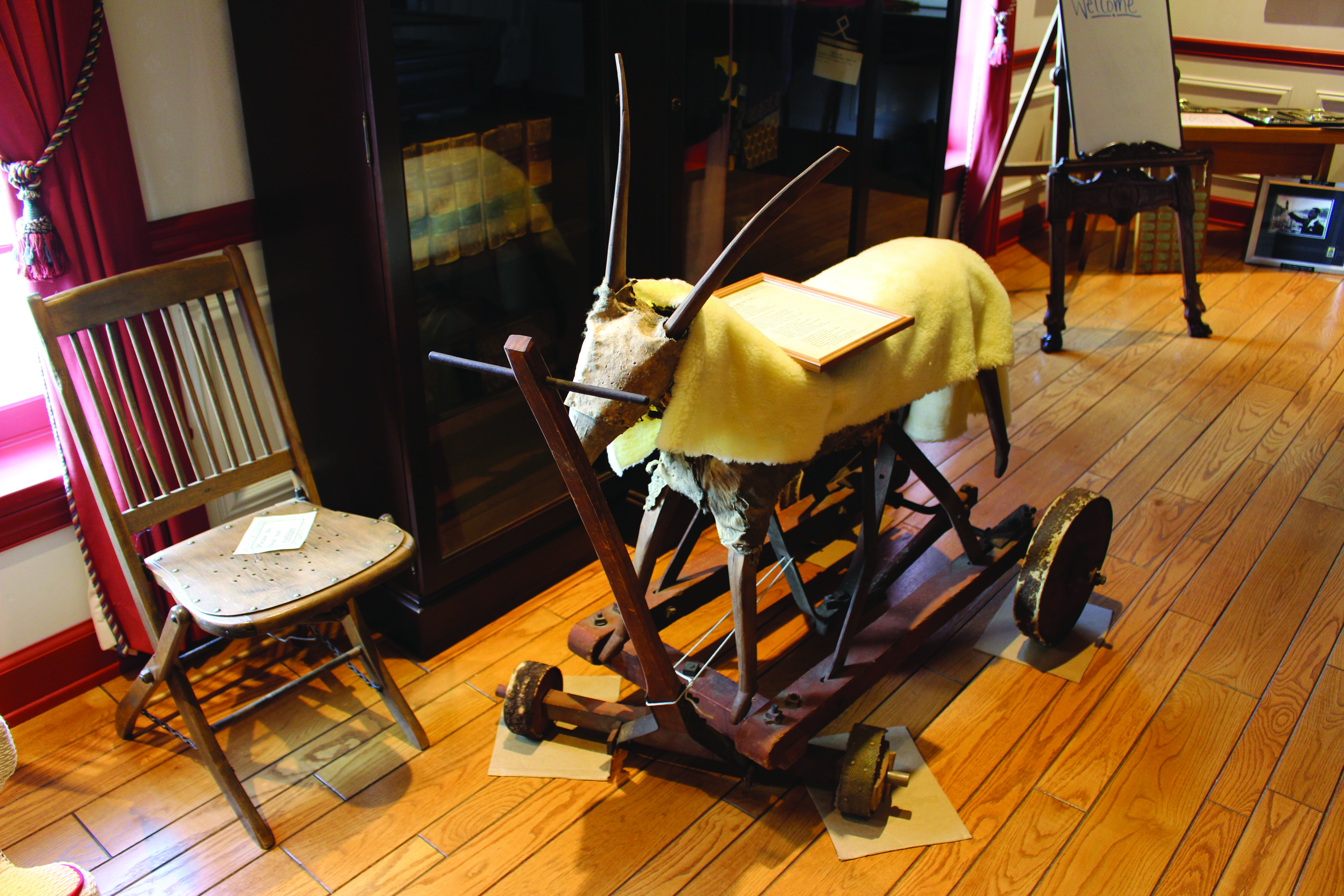
Life for farm families in the 1890s was difficult and dreary. A friendly get-together and wild stories were appreciated around a potbelly stove, and it didn’t matter if the storytellers stretched facts into legends. So it was with “riding the Gleaner goat” as an initiation. More than a century ago, it served as an unofficial mascot for Gleaner members and a source of tall tales and fun.
The 1890s were the golden age of fraternal societies. It is estimated that four out of every 10 men belonged to at least one group and many belonged to several societies. Initiation ceremonies were common among the groups, and “riding the goat” was used by several including the Elks, Modern Woodmen of the World and others. Ed DeMoulin, a promoter of the Modern Woodmen, formed DeMoulin Bros. in 1892 to sell initiation contraptions including trick chairs that collapsed when a person sat on them and mechanical goats mounted on wheels.
The men and women of each Gleaner arbor were free to choose if and how they initiated new members. Some had new members “ride the goat” while pulled around the room. The activity recalled the biblical journey by Ruth and Naomi from Moab back to Naomi’s hometown of Bethlehem. Arbors had fun embellishing results in The Gleaner magazine, such as this from Hudson Arbor (IN) in August of 1899: “We held our first meeting in the K. of P. [Knights of Pythias] hall, and you ought to have seen our goat prance around waiting for the candidate to put in an appearance. And when he did come in the person of Companion Conklin, who stands over six feet tall, is well proportioned and weighing, we should judge, over two hundred pounds you should have seen the goat begin to back up and shake his head. But he proved equal to the occasion as he made the trip from Moab to Bethlehem in good shape. This was a trial trip and all agreed that he was just the goat to keep.”
Some rides were rougher than others. In 1900, Sampson Arbor (MI), located at Colonville, reported, “Two of the candidates were a young married couple; the bride, having been initiated first, helped to make it interesting for her husband.”
Many arbors referred to mechanical goats as if they were real animals, but their fanciful tales were a mischievous wink at the truth. For example, Koylton Arbor (MI) related in the August 1895 edition of The Gleaner how members had a goat and “it was thought best to ‘de-horn’ him. The Chief Gleaner [President] grabbed a saw and other officers — including Inner Guard, Outer Guard, Conductor and Secretary — each grabbed a different part of the goat to hold.” It related how “with one bound,” the goat knocked down the officers “and the Conductor went sailing through the window on the goat’s back. A search was made for the Conductor, but he could not be found in the darkness. On the following day, however, he was found in a swamp below Clifford, Mich.” — nearly two miles away. “Things are once more in order in Koylton Arbor, but strangers must take the goat as he is, as no more attempts will be made to de-horn him.”
Since they were responsible to protect each other’s families with life and disability insurance, members’ rowdy reports may have been greatly exaggerated. The September 1901 Monthly Gleaner published a humorous poem about a farmer recovering from his initiation. It included this:
“… We leave the big piano shut
And do not strike a note;
The doctor’s been here seven times
Since father rode the Gleaner goat.
“He joined the lodge a week ago —
Got in at 4 a.m.
And 16 brethren brought him home
Though he says that he brought them.
His wrist was sprained, and one big rip
Had rent his Sunday coat —
There must have been a lively time
When father rode the Gleaner goat. …
“He has a gorgeous uniform,
All gold and red and blue,
A hat with plumes and yellow braid,
And golden badges, too.
But somehow, when we mention it,
He wears a look so grim,
We wonder if he rode the Gleaner goat —
Or if the Gleaner goat rode him!”
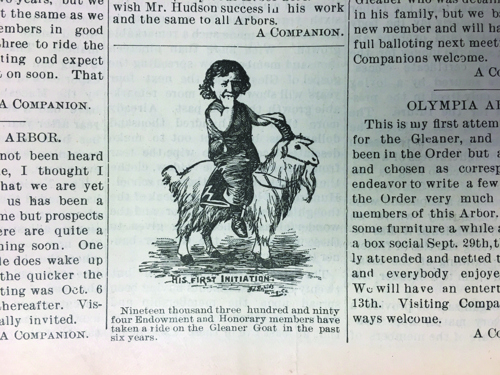 A cartoon goat appeared throughout the first few decades of the Society including in 1908 when it became the symbol of the monthly news column called “The Diary of the Gleaner Goat” about arbor activities. Another Gleaner Goat cartoon appeared in the 25th anniversary edition of The Gleaner.
Yet both America and the Gleaner Society were rapidly changing. By the 1920s, automobiles were taking rural residents far beyond their hometowns, and radios were bringing the world into their living rooms. As modernization accelerated, initiation ceremonies and other rituals became viewed as old-fashioned. The Gleaner Society expanded to include city residents and arbors focused more on providing strong life insurance solutions and other benefits. Recreation shifted to dances, picnics, and games like bingo and dartball.
The old mechanical goats are now found only in museums. One of these is the Oakfield Museum in Greenville, Michigan, which is located inside the historic Gleaner hall once used by Oakfield Center Arbor. However, the laughter of neighbors “riding the goat” still echoes in the good times enjoyed today as Gleaner arbors volunteer and celebrate together.